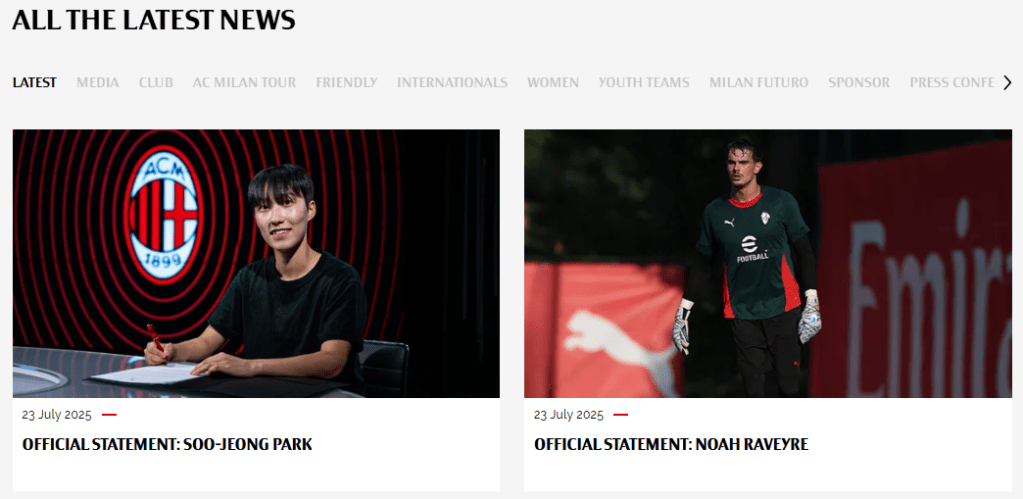
Korea international Park Soojeong has signed a three year contract with Serie A Femminile club AC Milan, the club announced yesterday. The 20-year-old forward, previously at Ulsan College, has been linked with the club for months but the transfer has now finally been made official. Park becomes the first Korean woman to play for AC Milan and the second to play in Italy, following in the footsteps of long-time teammate and close friend Kim Shinji, who joined AS Roma earlier this year.
Park and Kim both started their careers in the school football academies of Pohang, on the east coast of Korea. The age-mates came up together through Sangdae Elementary School, Hangdo Middle School and Pohang Girls’ Electrical High School (PGEH). The formidable pair have also represented Korea at youth level before making their senior international debuts within months of each other (Kim in November 2024, Park in May 2025). The Pohang schools are powerhouses of girls’ football in Korea — Park and Kim also came up alongside FK Molde striker Jeon Yukyeong and Seoul City’s star goalkeeper Woo Seobin, among others.
Park Soojeong’s talent was recognised early — as an elementary schooler she received the Cha Bum-kun award as the ‘best female player’ nationwide and earned comparisons to Ji Soyun for her goalscoring ability and instinct. She continued to live up to this reputation at U15 level, scoring goals for club and country. At the 27th annual Queen’s Cup in 2019 she and Jeon Yukyeong shared the honour of top goalscorer as their team lifted the trophy. They claimed victory at the Queen’s Cup again for the next two years in a row, now in the U18 category with PGEH, and in 2022 Park scored the late equaliser that took the final against rivals Gwangyang Girls’ High into extra time. During Park’s time at the school, PGEH also claimed consecutive titles in the KWFF Spring Championship and Park herself was already a well-known name in women’s football circles by the time she started playing for Ulsan College.
With Ulsan, Park’s trophy collection only grew. When the team finished as runners-up in the 2023 Spring Championship, she was singled out for an Outstanding Player award. When they won at the Queen’s Cup in the same year, Park and teammate Lee Jinju (now at Suwon FC) were the tournament’s joint top goalscorers. In 2024 Park travelled to Uzbekistan to represent Korea at the U20 Women’s Asian Cup. The team reached the semifinals, but were knocked out by eventual champions North Korea. Their fourth place finish earned the team a place at the U20 Women’s World Cup, where Park scored a winner against Germany to take Korea into the knockout stage.

Park Soojeong received her first senior international call-up in May when she was named as part of Shin Sangwoo’s squad for two friendly matches against Colombia, held in Korea. As part of the starting lineup for the first match of the series, Park made a strong impression on her A match debut with her speed and skill. She was again called up for Korea ahead of the EAFF E-1 Football Championship this month but withdrew from the squad due to injury. Korea went on to win the tournament, despite fumbling several chances with poor finishing. The national team could perhaps benefit from some proven goalscoring talent in the shape of Park Soojeong and one-time on-pitch partner Jeon Yukyeong (unavailable for most of the EAFF tournament after being stretchered off in the first match), especially as they look ahead to next year’s Asian Cup.
Park is undoubtedly one of the rising stars of Korean women’s football and her move to AC Milan is indicative of her own talent and achievements, as well as being a credit to the schools and coaches that have supported her over the years. With a new cohort of talent now maturing, we can expect to see more success from Korea’s national teams, and seeing more Korean players heading to big-name clubs in Europe and elsewhere does help to raise the profile of women’s football and inspire the next generation. However, the continuing exodus of young players to clubs overseas is indicative of how far the WK League still has to come. If investment is not made into domestic clubs and competitions, Korea’s best young footballers will continue to follow better opportunities elsewhere. Around the world, women’s football has grown massively over the last few years, but the WK League has a lot of catching up to do to become a viable and attractive option for top-class players.


 WK League News
Leave a comment