Last week, we reported on the KWFF’s new entry system for WK League matches, under which spectators are required to scan a QR code before entering the stadium. Since then, the KWFF has officially unveiled the system, to mixed responses, and then put it into action on the first matchday of the season. Here’s what you need to know if you’re heading to a WK League game in 2026.
What is the QR code entry system?
The QR code entry system has been introduced to the WK League this season by the KWFF as a means of producing more accurate official attendance figures and gathering data on spectators. While it’s still free to watch WK League games (with the exception of Suwon FC home matches), those attending are required to scan a QR code before entering the stadium. Those who regularly attend WK League matches, or who want to keep track of which matches they have seen via the KWFF website, can generate a personal QR code that can be used throughout the season. For one-off visitors, more casual fans, non-residents of South Korea, or those who, for any reason, do not wish to create an online KWFF account, a single-use QR code can be generated for each match.
What has changed?
Previously, WK League matches (again, with the exception of Suwon FC) have had no form of ticketing or controlled entry, making attendance figures inaccurate at best, and leaving the KWFF with no information about crowds — for example, how many people are regular spectators and how many are WK League first-timers, not to mention demographic information about who is watching women’s football. While matches at all stadiums except for Suwon’s home ground are still free to attend, spectators are now required to ‘check in’ upon arrival, using the new system.
In recent seasons, Suwon FC has been the only WK League club to charge for entry and issue paper tickets. This is not changing, so fans watching at Castle Park will still need to purchase a ticket before entering the ground.
How to generate a personal QR code
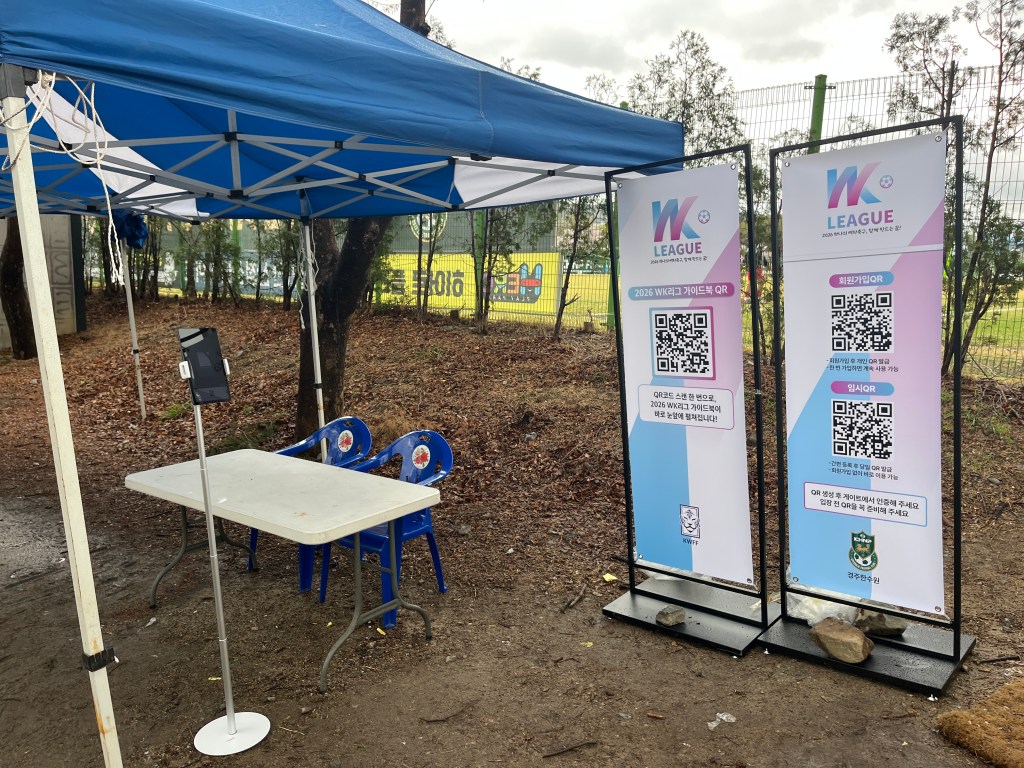
To generate a personal QR code for use throughout the season, a KWFF account is required. It’s relatively simple to set up, but phone verification is required, making this service inaccessible for non-residents of South Korea. If you haven’t set up an account yet, head to the KWFF website and click on the ‘login’ (로그인) button in the top right-hand corner, then click on ‘create account’ (회원가입) at the bottom of the screen to begin the process. Once you have an account and you are successfully logged in, you can find your QR code by clicking on ‘my page’ (마이페이지), at the bottom of the screen on mobile, or the person icon next to ‘logout’ (로그아웃) in the top right if using a desktop browser. Click on the QR code to enlarge it — it is also possible to save a screenshot of the QR code, or even print it out if you prefer to keep it handy. When you arrive at a stadium to watch a match, scan your code on the tablet near the entrance, in a process that will feel oddly familiar to anyone who was around in 2021.
How to issue a single-use QR code
For those unable or unwilling to create an online account and generate a personal QR code, a single-use QR code can be issued for each match. A smartphone with an internet connection is required. Upon arrival at the ground, you will see a tablet for ‘check in’, and banners displaying QR codes. Look for the one labelled ‘임시QR’ (‘temporary QR’) and use your phone camera to scan it. This should take you to a form that requires you to input your name, date of birth, and gender. We have been assured by the KWFF that a Korean phone number is not required to issue a single-use QR code. Once you have filled in the required information, submit the form to produce a code, then scan it using the tablet before heading to your seat. Remember, this code will only work for one match — if you go to another game later in the year, you will need to repeat the process to issue a new one.
How have WK League fans responded to the change?
The new entry system has prompted mixed responses from fans, who have voiced several concerns about its implementation. Some have been more critical than others, but virtually all are united in the opinion that the KWFF’s announcement of the new system, the day before the start of the season, was too late. Some fans attending Saturday’s matches knew nothing of the QR code system before arriving at the ground, and even those who did know in advance had little time to familiarise themselves with the process. There has also been criticism of the KWFF’s description of the system as a “more convenient entry system”, pointing out that it can’t possibly be more convenient than the previous system of… just walking in.
Some WK League regulars have expressed concern that the system adds a barrier to attendance that may put off not only new fans, but also some existing ones. Comments on the KWFF’s social media point out that a significant number of the league’s attendees are of a generation that may be less likely to have a smartphone or be familiar with this kind of technology. Furthermore, the nature of some WK League grounds and matches means that some people happen across games without knowing about them in advance, but end up watching since it’s free, and in some cases, become regular spectators. Some argue that the QR code system will mean these potential new fans will be less inclined to stay, with the result that the growth of the league may be stunted.
Others have questioned the need for the KWFF to collect data such as date of birth and gender from spectators, especially minors, and argued that if matches are still free to watch, the entry system is rendered unnecessary. While it is completely understandable for individuals to be cautious with their personal data, it is also worth bearing in mind that this is hardly an issue unique to the WK League — many people regularly purchase tickets for other sporting events, including the country’s top men’s football leagues, using ticketing services that are linked to government-issued ID. For anyone really concerned about their personal data, it is still technically possible to watch the WK League by using a single-use QR code each time and entering false information, since ID verification is not required.
While the KWFF has stated that a phone number is not required to attend a match, any system requiring an internet connection is likely to cause issues for those on short-term visas, including tourists, exchange students, and foreign military personnel. Of course, it is also possible for residents to have technical issues, whether it’s internet connectivity or simply a dead battery, but we have to assume that matchday staff will be sympathetic to such cases.
The response has not been unanimously negative — some commenters have welcomed the change, taking it as a sign that the KWFF is, at the very least, trying something. This is clearly not intended to be a long-term system. It’s a move towards a league-wide paid ticketing system, an important step in the professionalisation of the league. Over the years, spectators have got used to the openness and affordability of the WK League. They have also got used to promises of change and development being left unfulfilled. It is understandable that fans are skeptical about change, but if the WK League is to professionalise and expand, some changes to the fan experience will be necessary.


 WK League News
Leave a comment